The Five Solas: Five Truths Worth Standing On
“For from him and through him and for him are all things. To him be the glory forever! Amen.” — Romans 11:36
Every once in a while, I come across one of those church words that sounds much more complicated than it really is. The Five Solas definitely qualify. Say them in Latin and suddenly it sounds like we should be sitting in a seminary classroom surrounded by very large books.
But don't let the Latin scare you.
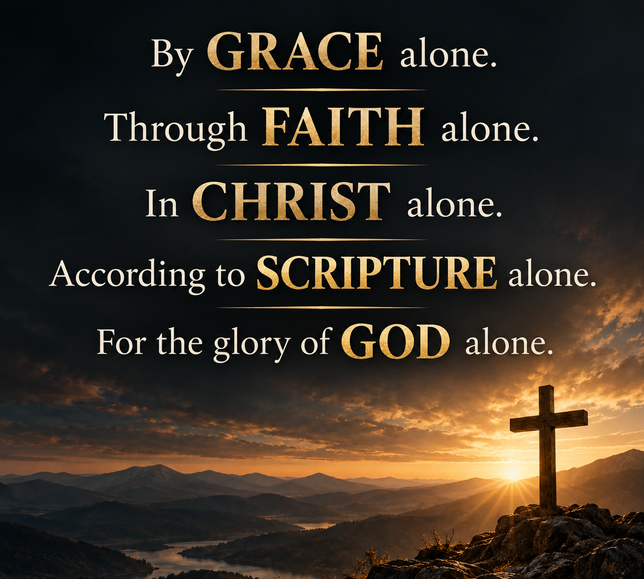
The Five Solas grew out of the Protestant Reformation more than 500 years ago as Christians sought to recover foundational truths taught in Scripture. Sola means alone, and these five statements summarize some of the most important truths of the gospel: Scripture alone, faith alone, grace alone, Christ alone, and the glory of God alone.
These aren't dusty theological ideas that only matter when studying church history. They answer questions Christians still wrestle with every day. How can I be right with God? Have I done enough? How do I know what's true? Is Jesus really the only way? Why would God save someone like me? And what is my life ultimately supposed to be about?
When you put the Five Solas together, something beautiful happens. They take the spotlight off us and put it exactly where Scripture says it belongs—on God.
Saved Through Faith Alone — Sola Fide
“For we maintain that a person is justified by faith apart from the works of the law.” — Romans 3:28
Sola Fide means faith alone, and at the heart of it is the biblical doctrine of justification. Scripture teaches that sinful people are declared righteous before God through faith in Jesus Christ—not because we have accumulated enough good works to deserve it. Paul writes that “all have sinned and fall short of the glory of God” and are “justified freely by his grace through the redemption that came by Christ Jesus” (Romans 3:23–24).
That can be surprisingly difficult for us to accept because we like contributing something. We understand earning a paycheck, getting a grade, or working toward a promotion. Surely salvation should work the same way. Attend church, read your Bible, be kind to people, stay out of serious trouble, and eventually the good side of the scale outweighs the bad. The problem is that Scripture never describes salvation that way.
Paul says, “A person is not justified by the works of the law, but by faith in Jesus Christ” (Galatians 2:16). Our confidence before God rests entirely in what Jesus accomplished, not in our spiritual résumé. We come to Christ with empty hands and trust His righteousness rather than our own.
But here's an important distinction: faith alone saves, but saving faith never remains alone. James tells us that faith without works is dead (James 2:17). James isn't contradicting Paul. Paul is explaining the root of salvation; James is describing its fruit. Good works don't purchase salvation. They become evidence that genuine faith has taken root. We don't obey Christ hoping He will finally accept us. We obey because, through faith in Christ, He already has.
Scripture Alone Has the Final Word — Sola Scriptura
“All Scripture is God-breathed and is useful for teaching, rebuking, correcting and training in righteousness.” — 2 Timothy 3:16
We live surrounded by voices. Pastors have opinions. Authors have opinions. Podcasts definitely have opinions. Social media can provide approximately seventeen different opinions before you've finished your morning coffee. So when those voices disagree, who gets the final word?
Sola Scriptura means Scripture alone is the final, infallible authority for Christian faith and practice because Scripture is God's written Word. It doesn't mean pastors, teachers, creeds, commentaries, or church history have no value. They absolutely do. God has given teachers to His church (Ephesians 4:11–12), and we would be foolish to ignore two thousand years of Christians studying Scripture before us. But every human authority remains underneath God's Word.
I love the example of the Bereans in Acts 17. They eagerly received Paul's teaching, but Luke says they “examined the Scriptures every day to see if what Paul said was true” (Acts 17:11). Think about that for a moment. They checked the Apostle Paul's teaching against Scripture—and Scripture was the standard.
That's still a wise practice. A favorite pastor can be wrong. A popular Christian book can be wrong. I can be wrong. You can be wrong. Our feelings certainly aren't infallible. But Jesus prayed to the Father, “Your word is truth” (John 17:17). Sola Scriptura reminds us that we don't reshape Scripture to fit the culture, our preferences, or our experiences. Instead, we allow Scripture to reshape us.
Christ Alone Is Enough — Solus Christus
“For there is one God and one mediator between God and mankind, the man Christ Jesus.” — 1 Timothy 2:5
Solus Christus means Christ alone, and perhaps no Sola takes us closer to the center of Christianity. Scripture teaches that Jesus Christ is the one and only mediator between sinful humanity and a holy God. We don't reach God through our goodness, religious rituals, another person, or another spiritual mediator. We come through Christ.
Jesus didn't leave any ambiguity about this. He said, “I am the way and the truth and the life. No one comes to the Father except through me” (John 14:6). In a culture uncomfortable with exclusive truth claims, those words can sound narrow. But look at them from another direction: there is a way to God. God Himself provided it.
Peter explains the gospel beautifully: “Christ also suffered once for sins, the righteous for the unrighteous, to bring you to God” (1 Peter 3:18). I love those last five words—to bring you to God. Jesus didn't merely come to improve our behavior or give us a good example to follow. The righteous One stood in the place of the unrighteous so sinners could be reconciled to God.
And His work was sufficient. Hebrews tells us Christ offered Himself “once for all” (Hebrews 10:10). That's why Jesus could declare from the cross, “It is finished” (John 19:30). Christianity isn't Jesus plus our goodness, Jesus plus religious achievement, or Jesus plus anything else. Our salvation rests completely in the finished work of Christ.
Salvation Is Grace from Beginning to End — Sola Gratia
“For it is by grace you have been saved, through faith—and this is not from yourselves, it is the gift of God.” — Ephesians 2:8
If Sola Fide explains how salvation is received, Sola Gratia reminds us why salvation is possible in the first place.
Grace alone.
Grace means God gives us what we could never earn and certainly don't deserve. Paul makes this wonderfully clear in Romans 5:8: “God demonstrates his own love for us in this: While we were still sinners, Christ died for us.” Notice the timing. Christ didn't wait until we became respectable Christians. He didn't wait until we cleaned ourselves up or promised to do better.
While we were still sinners.
That's grace.
But here's something I think we sometimes overlook: grace doesn't stop after salvation. Paul tells Titus that “the grace of God has appeared that offers salvation to all people,” and then immediately says that this same grace teaches us to say no to ungodliness and live godly lives (Titus 2:11–12). Grace doesn't merely forgive us. Grace begins transforming us.
That means grace is never permission to remain unchanged. The grace that saves also sanctifies. From the moment God awakens our hearts to the gospel until the day we stand before Him, the Christian life is a testimony to His grace. We never graduate from needing it.
Everything Is for God's Glory Alone — Soli Deo Gloria
“So whether you eat or drink or whatever you do, do it all for the glory of God.” — 1 Corinthians 10:31
The first four Solas lead naturally to the fifth. If salvation is revealed in Scripture alone, comes by grace alone, is received through faith alone, and rests entirely on Christ alone, then there really isn't much room left for us to boast, is there?
Soli Deo Gloria means to the glory of God alone. Paul asks the Corinthians, “What do you have that you did not receive?” (1 Corinthians 4:7). It's a wonderfully humbling question. Our salvation, gifts, opportunities, resources, abilities—even our next breath—ultimately come from God.
But God's glory isn't limited to what happens inside a church. Paul says even something as ordinary as eating and drinking can be done for God's glory. That means folding laundry can glorify God. Doing your job with integrity can glorify God. Loving a difficult person can glorify God. Serving someone when nobody notices can glorify God. Apparently, we don't need a microphone, ministry title, or mission trip to live a life that matters for eternity.
John the Baptist expressed this posture beautifully when people began telling him that crowds were leaving his ministry to follow Jesus. Instead of protecting his platform, John responded, “He must become greater; I must become less” (John 3:30). That's Soli Deo Gloria in everyday language. My life isn't ultimately about making my name known. It's about making His known.
And when we understand the gospel correctly, that's exactly where we end up. Grace leaves no room for pride. Faith leaves no room for boasting. Christ leaves no room for another Savior. Scripture leaves no room for another final authority. It all points back to God.
Closing: Five Solas, One Gospel
Five little Latin phrases written centuries ago still speak powerfully to the questions we carry today.
When you wonder whether you've done enough to earn God's acceptance, remember Sola Fide. Your confidence isn't in your performance; it's in Christ received by faith.
When you're surrounded by competing voices and wondering what is true, remember Sola Scriptura. God's Word remains the final authority.
When you're tempted to believe you need Jesus plus something else, remember Solus Christus. His finished work is sufficient.
When your failures make you wonder whether God could possibly still want you, remember Sola Gratia. Salvation was never based on your deserving it in the first place.
And when life starts becoming a little too much about your plans, accomplishments, recognition, or reputation, remember Soli Deo Gloria.
It all belongs to Him.
That's what I love about the Five Solas. They continually take our eyes off ourselves and redirect them toward Jesus. They remind us that Christianity isn't ultimately the story of what we've done for God.
It's the story of what God has done for us.
By grace alone. Through faith alone. In Christ alone. According to Scripture alone. For the glory of God alone.
And that is very good news.